

What is the Male Loneliness Epidemic?
While seemingly hyperbolic and slightly ironic in a world built by the patriarchy, this term has raised significant awareness (and eyebrows) about the increase of single, friendless men.
The “male loneliness epidemic” is a term increasingly used by psychologists, sociologists, and public health researchers to describe rising social isolation in men. Young men’s mental health crisis has ripple effects on mental health, relationships, and society.
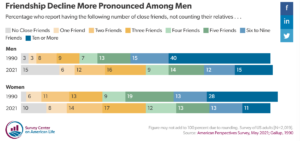
Statistics on the male loneliness epidemic from Gallup polls and the American Perspective Survey are showing a stark difference in the social networks of men versus women:
- 25% of men and 18% of women under 35 report feeling lonely frequently
- 15% of men versus 10% of women report having no close friends
- American men aged 15-34 are the loneliest in the Western world
Why Are Men So Lonely?
The Post-Pandemic Epidemic
Young men have been on a downward slide of social isolation since 1990, with the issue taking an unabated freefall after the COVID-19 pandemic.
With social distancing, remote work and school, and a general impending sense of doom about the future, it is not surprising that the pandemic made us all homebodies.
But even as Covid restrictions lifted, the damage was already done and significantly impacted how young men were interacting. It also permanently damaged many social programs due to funding or staffing, and businesses like malls, once a great third place for teens to mingle with their peers.
Years of not exercising their socialization muscles have stunted the growth of young men’s ability to make friends, maintain relationships, and date.
They Need To Go “Touch Grass”
Another issue stemming from the pandemic was our reliance on technology to get us through. While helpful in maintaining one’s social life in 2020, it became a crutch for people long after social distancing had ended.
This has led to a generation that prefers to stay inside with their devices; So much so that terms like “chronically online” and “go touch grass” exploded to make fun of people who seemed like they’ve never been outside a day in their life.
The content they’re consuming is also spoon-fed to them; Social media has specific algorithms that identify who you are, what your vulnerabilities are, and figures out what ideas they can push and what products they can sell you.
After you’ve been analyzed, 70% of the content you’re shown is based upon it.
This leads to people getting stuck in an echo chamber where everything they’re seeing feeds into their belief system, so they don’t even know that their opinions aren’t widely held, accepted, or even factual, separating them even further from reality.
Doom-Scrolling Into the Manosphere
Since the 2020 election, the algorithm specifically targeted young men with what’s called “red-pilled” content– which often leans far-right, misogynistic, and full of conspiracy theories.
It can start with them simply searching for advice on how to talk to women, and quickly sending them down the “manosphere” rabbit-hole.
This platform has made influencers such as Andrew Tate, Charlie Kirk, and Joe Rogan able to profit off young men grappling with their masculinity and frustrations with education, the job market, and dating.
There’s also a non-insignificant prevalence of autism in this community that suggests their preexisting struggles with social interaction, tendency towards literal thinking, and desire for belonging make them particularly susceptible to this rhetoric.
The manosphere targets these vulnerable men, stigmatizes mental health care, increases their feelings of depression and worthlessness, and then provides maladaptive coping mechanisms and someone to blame.
This increased misogyny has had a hand in the upward trend of femicide, as well as increases in school shootings, sexual and dating violence, and depression in their female teachers and peers.
Involuntary Celibacy or Natural Selection?
Young men are the most single of U.S. demographics.
Due to this, the internet coined the term “incel” – involuntarily celibate, or those who want to and try to date and have sex.
Incels often blame women for their inability to meet dating standards, but they haven’t realized the game has changed.
Since the creation of birth control, increases in education, and the ability to have their own credit and bank accounts, women have been able to support themselves on their own. Marriage is no longer a financial necessity, and thus freed women to seek partners with skills and traits they want instead of need.
Women now want softer, kinder men who can offer domestic labor, child-rearing, and emotional intelligence.
Despite this shift in mate selection, young men were still raised with the idea that their sole purpose is to be the breadwinner. They were told that a women’s place is in the kitchen, that they must play with action figures instead of baby dolls, and that men don’t cry.
Society failed these men by not expanding what it means to be a provider, and to educate them on these in-demand skills. We ripped away sewing, cooking, and home-ec classes in schools, degraded the trades, and made nursing and teaching “women’s work”.
Young men are aimlessly searching for purpose in this modern age, with none of the skills or emotional intelligence to navigate it. It is no wonder they are depressed and unmotivated to not just date but join the work force or pursue education.
A Generation of Lost Boys
Women have made hard-earned strides in the last couple decades; Katy Perry went to space, we almost had a woman president (twice), and women became the majority of students in higher education and new homeowners.
While we told women they could do and be anything they wanted, we forgot to uplift our young men along with them.
Since 1990, the rate of men aged 16-24 who are “NEET” (Not in Education, Employment, or Training) has increased, with 1 in 10 in the U.S. and 1 in 5 globally, and nearly 20% of young men are still living at home.
However, the rate for NEET women has steadily gone down, with the majority being single mothers, and single women outnumber men as new homeowners at a rate of 2 to 1.
This “failure to launch” suggests a particularly serious mental health crisis for men.
Without an education, self-esteem and long-term earning potential drop. Without a job, depression and anxiety increases and future-planning drops. Living with their parents means they have trouble bringing a girl home, and arrested development domestically and emotionally.
And if you don’t launch, you can never thrive.
How Men’s Loneliness Affects Everyone
Men’s loneliness is a public health and societal issue, and it’s everyone’s responsibility to ensure our future generation of boys are not left behind.
Society faces many potential consequences due to this epidemic, such as:
Poor Mental Health:
- Men’s isolation has led to more loneliness for both men and women, which increases the risk of depression, anxiety, substance abuse, self-harm, and suicide.
Economic Struggles:
- Lonely individuals show higher rates of absenteeism, disengagement at work, and long-term unemployment.
- Lower rates of education and employment contribute to labor shortages and increased social security spending.
Increased Violence:
- Online rhetoric can contribute to:
- Higher levels of misogyny, which has increased sexual violence and femicide.
- Higher levels of antisematism, homophobia, and transphobia, which has increased hate crimes, according to the Civil Rights organization.
- An increase in mass shootings
How Do We Fix the Male Loneliness Epidemic?
There is no one fix. This will require instrumental, intentional change.
This means it’s EVERYONE’s responsibility to help fix the male loneliness epidemic.
And no, I’m not saying women should lower their standards and men should just get over it.
We must ensure we are making impactful change through modeling, showing up for others, and changing the stigma.
Forming Strong Friendships
- Talking openly about their life and struggles
- Showing up for others emotionally and physically
- Making the effort to reach out and maintain relationships
Community involvement
- Starting or joining sports leagues or clubs
- Volunteering within your community, such as Big Brother/Big Sister
- Creating safe third spaces for youth to hang out
Mental Health
- Destigmatizing therapy
- Stop perpetuating stereotypes, like “men don’t show emotion”
- Offering emotional support
Becoming a Role Model
- Showing emotions other than anger
- Modeling healthy relationships and kindness
- Calling out other men for hateful rhetoric
Positive Enforcement
- Praise and foster skills and interests from a young age
- Encourage playing outside, seeing friends, joining activities
- Explain the options of college education, vocational school, and job prospects — and that they’re all equal
Therapy for Men’s Mental Health in Massachusetts
Handel Behavioral Health understands the impact that loneliness and societal expectations can have on men’s mental health.
HBH’s compassionate and judgement-free therapists can help you understand the deeper causes of your loneliness and depression, and create a comprehensive treatment plan that meets your mental health needs and goals in life.
You will be able to learn new, healthy coping mechanisms to help you gain awareness of what’s triggering these issues and how to actively overcome what is holding you back from living a fulfilling life.
Our dedicated client care team will assist you with scheduling an appointment with one of our therapists as quickly as possible, usually within a day or two.
Our therapists are available for appointments online in Massachusetts or in-person from our offices in Amherst, Franklin, West Springfield, Wilbraham, or Natick offices.
Contact us today at (413) 343-4357 or request an appointment online.
About The Author