
Finding Yourself on The Spectrum of Gender
Understanding Gender Identity, History, and Gender-Affirming Care
February 5, 2026

Gender identity is a deeply personal part of who we are, yet it is often misunderstood, politicized, or oversimplified. For many individuals, exploring gender identity can bring clarity and empowerment. For others, it may come with confusion, stress, or emotional pain—especially when met with stigma or lack of support.
Last week at HBH’s all-hands meeting, one of our therapists, Sarah Hart, presented on the historical, social, and psychological context of gender identity.
Understanding this background is a crucial part of providing our therapists with the tools to provide the ethical, effective, and compassionate gender-affirming care that our clients deserve.
A Brief History of Gender Identity and Gender Politics
Gender fluidity is not a new phenomenon coming from TikTok.
Across cultures and millennia, gender nonconformity has been widely recognised. This can be seen in ancient Mesopotamia’s worship of Inanna and gender-fluid priests, ancient Greece’s self-castrating, feminine-presenting Galli, and Native Americans’ Two-Spirit identities.
In more modern centuries, notable figures include Frances Tompson, the first transgender person to testify in front of Congress after the Memphis Riots in 1866; Christine Jorgenson, the first transgender person to publicly transition with surgery in the 1950s; and Marsha P. Johnson, a highly lauded fighter of civil rights in the 1960s and 70s who participated in the Stonewall Riots.
The 1966 Compton’s Cafeteria Riot and the 1969 Stonewall Riots were both instigated by police raids of businesses patronized by gay and transgender people. Fed up with the frequent, targeted arrests, particularly of transgender people, protestors fought back to protect the few spaces that they felt safe to exist in.
These actions gave individuals the hope and courage to speak up for their rights, leading to continued activism for the rights of LGBTQ+ individuals, a fight that is still ongoing to this day.
With LGBTQ+ rights often used as a red herring or dangled as a threat, it is no surprise that the mental health of these individuals is systemically and negatively affected. This reiterates the necessity of affirming and respectful support from one’s community, family, and health providers.
The Genderbread Person
The Genderbread Person helps clarify concepts that are often incorrectly grouped together, validating that gender identity is not determined by expression, anatomy, or sexual orientation, and vice versa.
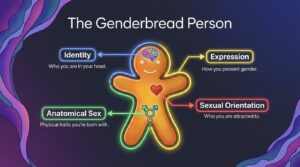
The Genderbread Person separates identity into distinct but related components:
- Gender Identity: A person’s internal sense of being a man, woman, both, neither, or another gender (ex., nonbinary)
- Gender Expression: How someone outwardly expresses gender through clothing, behavior, voice, or appearance (ex., masc/fem)
- Biological or Anatomical Sex: Physical characteristics such as chromosomes, hormones, and reproductive anatomy (ex., intersex)
- Sexual Orientation: Romantic or sexual attraction to others (ex., bisexual)
Gender-affirming therapists use this model to help clients communicate their experiences more clearly.
The Giant Plothole in the Gender Binary
It can be frustrating to hear people fight about “what is a woman” when it comes to things like reproductive rights. Particularly when the reliance on “science, biology, and anatomy” is used in defiance of using exclusive language.
There is a clear misunderstanding of the science of sex and the spectrum of not only identity, but of biological and anatomical sex.
Conditions such as Klinefelter Syndrome, Turner Syndrome, Androgen Insensitivity Syndrome, Congential Adreal Hyperplasia, 5-Alpha Reductase Deficiency, and Chimerism affect the chromosomal and physiological gender presentations of a combined ~0.568% of humans, which would be nearly 2,000,000 Americans.
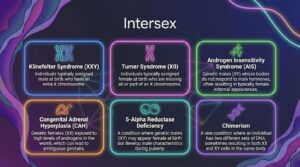
People should not be discriminated against due to the genitalia or hormonal variations they present with at birth. Using exclusive language is crucial in including everyone who can be affected by decisions about civil rights, healthcare, and even the overexaggerated “Bathroom Debate”.
The Spectrum of Gender Identities
Gender exists on a spectrum, not within a strict binary. While many individuals identify as men or women, others experience gender in more fluid or expansive ways.
Gender identity therapy supports individuals across this full spectrum, including but not limited to:
- Cisgender: Gender identity aligns with sex assigned at birth
- Transgender: Gender identity differs from sex assigned at birth
- Nonbinary: Gender identity outside the categories of man or woman
- Genderfluid: Gender identity that shifts over time
- Agender: Identifying as having no gender
- Bigender or Multigender: Identifying with more than one gender
While labels aren’t necessary, discovering language that accurately reflects their experience can be emotionally transformative and validating for many people.
What Does Gender Identity Have to Do With Mental Health?
Research consistently shows that transgender and gender-diverse individuals experience higher rates of anxiety and depression, violence, sexual assault, homelessness, and systemic trauma.
This often results from a lack of support from their families and communities, social stigmas that can lead to trouble processing and accepting one’s identity, and discrimination, such as in healthcare and housing.
Providing gender-affirming mental health care to those facing a world where they are yet to be fully understood and accepted is an ethical duty we take seriously here at HBH.
What is Gender-Affirming Care?
Gender-affirming care prioritizes understanding, respect, and autonomy. It does not attempt to change a person’s gender identity, but to provide support in the journey.
Gender-affirming care is a holistic approach that often includes a team of doctors, surgeons, mental health counselors, and, hopefully, one’s loved ones and community.
One of the most important aspects of gender-affirming care is using the client’s preferred pronouns and name. “Deadnaming” – using a person’s birth name instead of their chosen name – can be incredibly detrimental both to the individual’s mental health and their sense of safety and trust with their support system.
Here at HBH, we understand the complexities of gender identity and the necessity of our support for LGBTQ+ individuals.
We believe everyone deserves access to care that honors their identity and supports their well-being.
If you are looking for support in your gender-identity journey, HBH is here to clear the path. Our LGBTQ+ affirming therapists and psychiatrists are available for telehealth or in-person from our Massachusetts offices in Amherst, Franklin, West Springfield, Wilbraham, or Natick offices. Contact us today at (413) 343-4357 or request an appointment online.
About The Author

Andria Grant