
Gender Affirming Care in Massachusetts
Compassionate Support for Exploring Who You Are

Understanding your gender identity can be a deeply personal and sometimes complex journey. Whether you feel confident in who you are, questioning, or downright confused, you deserve support that is understanding, respectful, and affirming,
HBH offers gender affirming care for individuals who are seeking to explore their identity and help them build a life that feels authentic and sustainable.
What is Gender Identity?
Gender identity refers to a person’s internal sense of their gender and how they experience and understand themselves. Gender identity is not determined by appearance, behavior, or interests, and it exists independently of sexual orientation.
This may align with the sex assigned at birth or come in many different presentations. For some people, gender identity feels stable and clear from an early age. For others, it may evolve over time or feel difficult to define. All experiences of gender are valid, and there is no “right” way to discover or express who you are.
Types of Gender Identities
Gender exists on a spectrum, not a binary, that stretches in all directions with infinite possibilities in between.
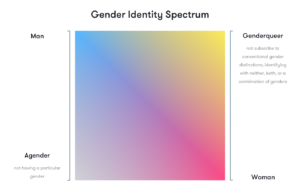
Some common gender identities include:
- Cisgender: A person whose gender identity aligns with the sex assigned to them at birth.
- Transgender: A person whose gender identity differs from their sex assigned at birth.
- Nonbinary: A gender identity that does not fit exclusively within “male” or “female.”
- Genderqueer: An umbrella term that may describe identities outside traditional gender categories.
- Agender: Identifying as having no gender or a neutral gender.
- Genderfluid: Experiencing shifts in gender identity over time.
These terms are tools, not rules. Some people use multiple labels, while others choose none at all. Gender identity therapy can be a supportive space to explore language, meaning, and self-understanding without pressure to reach a specific conclusion.
What It Can Feel Like to Question Your Gender Identity
Questioning your gender identity can look and feel different for everyone. Some people experience a quiet sense that something doesn’t fit, while others feel intense discomfort or distress. Common experiences may include:
- Feeling disconnected from your body or appearance
- Discomfort with being perceived or referred to as a certain gender
- Anxiety, confusion, or fear about the future
- Relief or clarity when imagining yourself as a different gender
- Guilt or shame related to family, culture, or religious beliefs
- Worry about how others might react
- Experimenting with different pronouns or appearances
It’s also common to question your gender during life transitions, such as puberty, adulthood, or parenthood. Exploring these feelings in gender affirming therapy can help you better explore and understand them without self-doubt or judgement.
How Lack of Support Can Affect Mental Health
When individuals do not receive understanding or affirmation around their gender identity, the impact on mental health can be significant. Being misgendered, dismissed, or pressured to conform can compound these challenges.
Having a gender nonconforming identity is not related to poor mental health outcomes outright. Rather, research consistently shows that lack of support is a major contributor to the negative outcomes of coming out.
Without gender-affirming support, individuals may experience:
- Increased anxiety or depression
- Chronic stress or emotional exhaustion
- Low self-esteem and internalized shame
- Lower quality of life from not living one’s full authentic self
- Social withdrawal or isolation
- Higher risk of self-harm or suicidal thoughts
What is Gender Affirming Care?
Gender affirming care is an approach to mental health that respects, validates, and supports a person’s self-identified gender. It does not assume a predetermined outcome nor push clients toward any specific identity, expression, or medical decision.
Instead, gender affirming therapy focuses on:
- Creating a safe, nonjudgmental space
- Exploring identity at your own pace
- Processing emotions related to dysphoria, stress, or uncertainty
- Building coping skills and self-compassion
- Supporting social, emotional, and relational wellbeing
Gender affirming care may be helpful whether you are questioning, exploring, transitioning, or simply seeking support in a world that may not always feel accepting.
How Therapy Can Help
Our gender affirming care services are tailored to each individual’s needs and goals. Therapy may include:
- Exploration of gender identity and expression
- Support around coming out or not coming out
- Navigating family, relationships, school, or workplace challenges
- Addressing anxiety, depression, or trauma
- Collaborate with healthcare providers and other members on the care team
- Strengthening confidence and self-advocacy
- Processing experiences of discrimination or invalidation
HBH and our therapists are here to support you where and when you need it. Our role is to walk alongside you, not to define who you are.
Looking for Gender Affirming Care in Massachusetts?
At Handel Behavioral Health, we believe that everyone deserves access to respectful, competent mental health care. Our therapists are trained in LGBTQ+ affirming therapy and understand the unique stressors faced by transgender, nonbinary, and gender-diverse individuals.
Whether you are seeking gender affirming care, gender identity therapy, transgender therapy, or simply a safe space to explore how you’re feeling, HBH is committed to providing care that honors your lived experience and supports your mental health.
If you are ready to begin your journey with us, our LGBTQ+ affirming therapists and psychiatrists are available for telehealth or in-person from our Massachusetts offices in Amherst, Franklin, West Springfield, Wilbraham, or Natick offices. Contact us today at (413) 343-4357 or request an appointment online.
About The Author