
Money Can Buy Happiness
How to Manage Financial Stress and Protect Your Mental Health
April 6, 2026
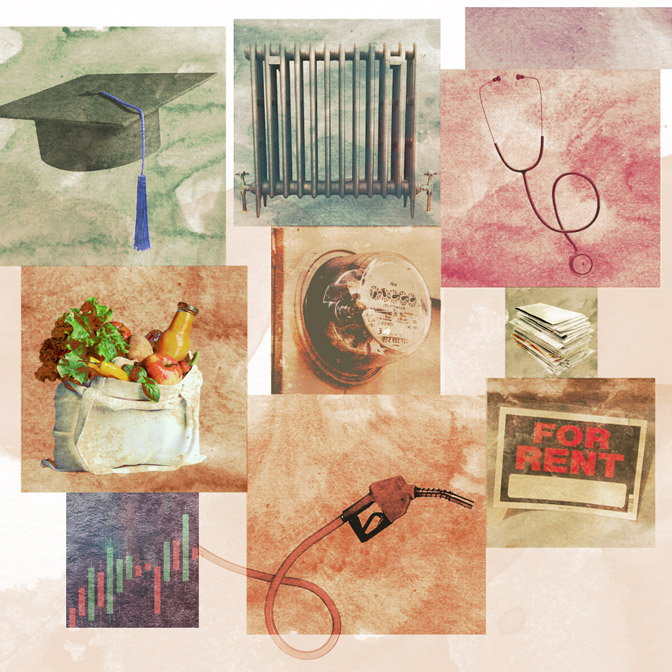
In the current economy, Americans are facing a slew of seemingly insurmountable financial struggles.
Financial stress and mental health have been consistently proven to be deeply intertwined.
Money buys happiness through stability and safety; it provides housing, healthy food, and clean water; it affords transportation, education, and healthcare; it enables retirement, parenthood, and relationships.
Being unable to meet one’s basic human needs can lead to chronic stress, anxiety, and depression.
Trying to improve your mental health without acknowledging financial reality can feel like a losing battle, and a good therapist will recognize how it factors into your mental health journey.
So let’s take a step back and a deep breath, and break it down.
The Big Shortchange
After the pandemic proved to companies that they could raise prices ad infinitum and pay the lowest wages possible with no consequence, wage disparities have skyrocketed.
The Global Wealth Report shows that the top 1% now control about 50% of the world’s wealth, and the bottom 80% sharing a mere 12.7%.
If you had 100 cookies:
- 1 person would get 50 cookies,
- 19 people would get roughly 2 cookies each,
- and 80 people would get 1/6 of a cookie each.
And that’s simply not what I learned in kindergarten about sharing.
The job market has suffered. Though reports boast millions of job openings, anyone currently seeking employment can tell you of record amounts of fake job postings, AI interviews, and ghosting recruiters.
This uncertainty and constant hustle to stay afloat.can lead to hypervigilance, burnout, and difficulty relaxing.
Those with preexisting mental health conditions can especially struggle to find and maintain a job, leading to a cycle of hopelessness and failure.
While we can’t hire you (unless you’re a therapist!), Handel Behavioral Health is here to help you make a plan to protect your mental health:
- Mental: Identify what you can and can’t control, such as the quality of your cover letters versus robots throwing your application in the trash before a human can even look at it. Understand there’s nothing wrong with you, but the system itself.
- Financial: Run your updated resume through an AI checker to ensure it’s not filtered out, and focus on writing 3 quality applications per day. Focus on making real-life connections and networking.
- Lifestyle: Take time to rest. Constant productivity doesn’t equal security.
Honey, I Shrunk the Groceries
Not only are Americans getting fewer cookies, but those cookies are smaller.
It is hard to deny that our grocery bill has gotten higher and higher, but these companies are trying to gaslight us about their slowly shrinking quantity and quality.
With shrinkflation giving us less, we have to buy more; And skimpflation comes with nutritional deficits, more waste, and planned obsolescence.
Constantly trying to keep your head above water can lead to chronic stress and anxiety, irritability, and burnout. Feelings of hopelessness about this ever-changing economy can become a lingering depression.
While we can’t lower the cost of goods, Handel Behavioral Health can offer some supportive strategies to ease financial stress:
- Mental: Acknowledge that you still have to buy toilet paper, and it’s okay to treat yourself to the good stuff. Don’t feel guilty about spending a bit more for quality to maintain your humanity and mental health.
- Financial: Find where small changes make bigger impacts, like rotating car insurance carriers, pausing subscriptions, or cancelling that Planet Fitness membership you haven’t been using.
- Lifestyle: Find low-cost joy like going for walks, attending free events, or hosting friends at home. Just don’t let your friends eat your expensive cookies (they’ll understand).
The American Dream is a Pipe Dream
Housing is a human right. Unfortunately, with rental prices skyrocketing and the possibility of saving up enough money to buy a house, the American Dream has become a Pipe Dream.
Those from Massachusetts or Rhode Island have seen how telecommuting has increased the radius of housing demand from Boston, leading to higher rents and home prices all the way to Providence.
So many are being priced out of the housing market that rates of homelessness have grown 13% just from 2023 to 2024, according to HUD. This disproportionally affects our most vulnerable groups, such as those with disabilities, severe mental illness, and substance abuse disorders.
Housing instability can put the body into survival mode. Constant vigilance and chronic anxiety have a devastating effect on one’s mental health and nervous system, leading to issues with sleep, concentration, and emotional regulation.
Being unhoused also increases the risk of violent and sexual assault, infectious diseases, and can lead to or exacerbate mental health conditions and substance abuse.
While we can’t buy you a house, Handel Behavioral Health has many compassionate and caring therapists who can provide resources and support, including mental health strategies such as:
- Mental: Ground yourself in what is stable— your routines, relationships, health, etc. — and maintain that stability and appreciation. Remember that housing instability is not a personal failure.
- Financial: When possible, consider shared housing or downsizing, find ways to reduce utility costs such as wrapping windows in the winter, or explore local assistance programs.
- Lifestyle: Be active in your community and help others when you can. You’ll be less afraid to ask for help if you need it, and you’ll already have a support system.
The Fundamentals of Caring
Despite being the only “first world” country without universal healthcare and having the lowest life expectancies, the U.S. spends twice as much money on healthcare.
After recent changes to ACA tax credits, monthly premiums skyrocketed on average $1,000 for the 23 million Americans who rely on the ACA for health insurance. Many will be unable or unwilling to pay these high premiums, leading to millions of Americans losing access to preventative care.
Hopefully, you have that baby before your coverage expires, because you’ll need the extra cash to pay 10% of your income on childcare. Obviously, you’ll have to go back to work immediately, as the U.S. is also one of the few countries without paid maternity leave.
And hopefully, that baby gets a job as soon as possible, because otherwise you’ll never be able to afford to retire. Hopefully, they become nurses too, because assisted living facilities in Massachusetts are about $7,000 a month, and nursing homes are nearly double.
While tomorrow is never promised, it may certainly come. Don’t fret too much over how much you are able to save and focus on making your life worth living.
Caring is what we do at Handel Behavioral Health. Our licensed mental health counselors can help unwind the knotted ball of stress and break it down into steps to maintain your physical and mental health:
- Mental: Acknowledge the fear without catastrophizing. Focus on next steps, not the entire future. Remember that your physical and mental health come first.
- Financial: For medical bills, you can request a payment plan (which often is accepted). For childcare, explore childcare sharing and local subsidies. For retirement, contributing small, consistent amounts and taking advantage of employer 401k matching.
- Lifestyle: Making good choices can lead to net gains in terms of physical and mental health. This includes things like quitting smoking, family planning, and controlling discretionary spending.
We’re All In This Together
Many of these stressors are systemic, not personal failures. When we internalize financial struggles as personal shortcomings, our mental health suffers.
There is a lot outside of our control, but the majority of Americans have one thing in common: a cost-of-living crisis.
One of my favorite movies to watch during the 2008 financial crisis was High School Musical, which reminded us that we are all in this together:
“We’re all here
And speaking out with one voice
We’re going to rock the house,
The party’s on, now everybody make some noise
Come on, scream and shout”
That is to say, our biggest power is our collective voice. Building community around this shared struggle can ensure that systemic change is possible. The everswinging pendulum will one day swing in the favor of the people, but not without an extra push.
Looking For Help With Financial Stress?
Handel Behavioral Health is a family-owned business in Massachusetts, so we fully acknowledge that the rising cost of living is also creating a mental health crisis.
Our licensed therapists are too in this with you, and can help you regulate your nervous system, improve well-being, and help you make a realistic plan to protect your mental health during times of financial strife.
If you are looking for mental health counseling in Massachusetts, HBH is here to help. We offer both telehealth/online therapy as well as in-person therapy at our offices in Amherst, Springfield, Wilbraham, Natick, and Franklin Massachusetts. Call (413) 343-4357 or request an appointment online today to get started.
About The Author